
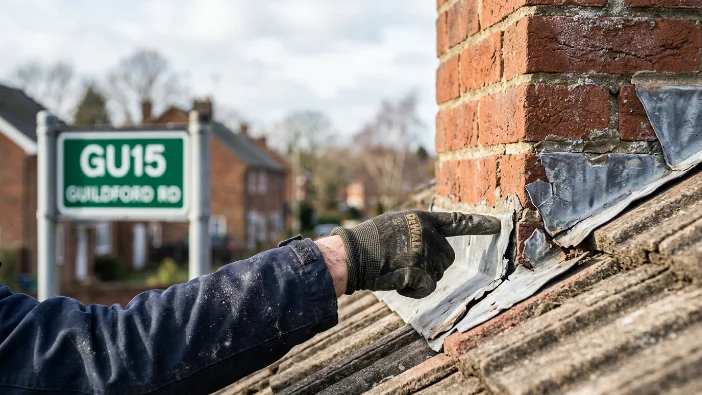
Winter in Surrey is not the harshest in the UK — but it does not have to be extreme to damage your roof.
Camberley gets a combination of heavy rain from October through February, the occasional sharp frost, and the kind of gusty wind that loosens old mortar and shifts poorly bedded tiles. By the time spring arrives, many homes in GU15 have roof problems that were not there six months earlier.
The issue is that most of this damage is invisible from the ground. You will not know it has happened until water starts coming in — and by then, the repair bill is always bigger than it needed to be.
This guide is written for homeowners in Camberley, Mytchett, Frimley, Deepcut, and the wider GU15 and GU16 postcode area. We will walk you through what winter does to roofs in this area, what to look for in spring, what repairs typically cost, and how to find a roofer who will not waste your time or money.
What Winter Actually Does to a Camberley Roof
Most roof damage does not happen in one dramatic storm. It builds up gradually over a whole season. Here is how:
Frost gets into small cracks and makes them bigger. Water works its way into a hairline crack in a tile or in ridge mortar. When it freezes overnight, it expands. By morning, that crack is wider. Repeat this ten or fifteen times across a winter and what started as a hairline crack is now a gap big enough to let water through.
Rain pushes into gaps that dry weather hides. In summer, a slightly loose tile may not cause any visible problem. Driven rain in November hits that same tile at an angle and forces water underneath. Most homeowners only find out when a damp patch appears on a bedroom ceiling in January.
Wind lifts and shifts tiles on older roofs. Camberley has a lot of housing stock from the 1960s and 1970s, especially around Old Dean, Watchetts, and the streets off the A30. On these roofs, tiles are often set in old mortar that has long since lost its grip. A 40mph gust — not unusual between November and February — is enough to shift them.
Moss absorbs moisture and holds it against your roof. Surrey’s damp winters are perfect growing conditions for moss. Thick moss on tiles acts like a sponge, keeping your roof wet for much longer than it should be after rain. Over time, this leads to tile degradation and, on flat roofs, can cause premature felt failure.
The Camberley Housing Mix — and What It Means for Your Roof
Knowing your property type helps you understand where problems are most likely to appear.
Old Dean and Watchetts estate properties (1960s–1970s semi-detached and terraced): These are the most common source of winter roof repair calls in GU15. The original mortar on ridge tiles and verges has often never been replaced. By now it is crumbling. Tiles on these roofs are also heavier concrete tiles that were popular in this era — they hold water, grow moss quickly, and put more stress on ageing timber frames underneath.
Victorian and Edwardian properties near Camberley town centre: Older clay or natural slate roofs that have been well maintained can last a very long time. But in this age bracket, chimneys are often the weak point. Old brickwork and lime mortar on chimney stacks becomes porous after decades of wet winters, and lead flashings around the base of chimneys work loose. Both issues are common causes of internal water damage that appears in winter.
Frimley and Mytchett newer builds (1980s–2000s): Concrete interlocking tiles are the norm here. They are durable but do crack, and mortar ridge systems eventually fail. Flat-roofed garages and rear extensions on these properties are often now 20–30 years old — many are at or past their expected lifespan.
Modern estates (Camberley town centre regeneration areas, parts of Frimley Green): Newer properties are generally lower risk, but dry ridge systems still need periodic inspection. Guttering on newer builds is often plastic and can warp or pull away from fascias after cold winters, causing hidden water ingress behind the roofline.
6 Things to Check on Your Camberley Roof After Winter
You do not need to go up on the roof yourself. A pair of binoculars and a walk around your property on a dry day will show you most of what you need to know.
1. The ridge line Stand at a distance and look along the top of your roof. The ridge should be a straight, even line. Any dips, gaps between tiles, or sections where mortar has clearly fallen away need attention before the next winter.
2. Verge mortar (the edges of the roof) Look at the sloping edges of your roof — the verge. Old mortar here is one of the first things to go. If it looks crumbly, patchy, or pieces are missing, it is time to get it repaired or upgrade to a dry verge system.
3. Individual tiles Look for tiles that are cracked, lifted at one edge, or simply missing. Even one absent tile is a water entry point. Also look for tiles that have slipped down slightly — they may not be missing but they are no longer doing their job.
4. Gutters and downpipes Check for gutters that are visibly sagging, pulling away from the fascia, or that have plants growing in them. Blocked gutters are one of the most common causes of damp in walls and rotting fascia boards. They are also one of the cheapest problems to fix if caught early.
5. Your loft (on a bright day) Go up into your loft on a sunny morning and turn the light off. Give your eyes a moment to adjust. Any daylight coming through from above means there is a gap somewhere in your roof covering. Also look for dark staining on the timbers — this indicates water has been getting in at some point, even if there is no active leak right now.
6. Chimney and flashings If your property has a chimney, binoculars are useful here. Look for white staining on the brickwork (a sign of moisture moving through), missing or cracked pointing at the top, or lead flashing around the base that has lifted away from the stack.
What Do Roof Repairs Cost in Camberley?
Here are realistic price ranges for common repair jobs in the GU15 area, based on 2025–2026 rates:
| Repair | Typical Cost |
|---|---|
| Single tile replacement | £80 – £150 |
| Ridge tile re-bedding (per section) | £200 – £500 |
| Full ridge re-point or dry ridge upgrade | £500 – £1,200 |
| Verge mortar repair or dry verge installation | £300 – £800 |
| Chimney repointing | £350 – £750 |
| Lead flashing replacement (chimney) | £300 – £600 |
| Flat roof repair (patch) | £150 – £400 |
| Flat roof full replacement (garage/extension) | £900 – £2,800 |
| Gutter replacement (full run) | £300 – £600 |
| Emergency same-day call-out | £150 – £300 call-out + repair cost |
These are guide ranges only. Your final price will depend on the size of your roof, the pitch, how easy it is to access, and the exact extent of the damage. Always get at least two written quotes for any job over £500.
Repair Now or Wait Until Something Goes Wrong?
This is the question most homeowners ask, and the honest answer is always: repair now.
Here is why.
A loose ridge tile that costs £200 to re-bed in spring can fall off in a gust and crack three other tiles on the way down. Now you are looking at £500 or more. A small leak above a bedroom that starts as a damp patch costs a few hundred pounds to fix at roof level — but if you leave it, the water moves into the timber joists and the ceiling plasterwork. Suddenly you are dealing with a roofing bill and a plastering bill.
The jobs that seem minor in spring are the ones that cause the most expensive damage by the following winter if they are ignored.
The one exception is if your roof is genuinely old across the whole surface. If tiles are failing in multiple places, if timbers are showing signs of widespread rot, and if you have had repeated repairs over the past few years, a full replacement is often better value than continuing to patch. A roofer worth trusting will tell you honestly which situation you are in.
How to Find a Good Roofer in Camberley
Camberley is well served by local roofers — but as with any trade, quality varies. Here is what to look for:
Verified reviews, not just a website. Anyone can build a website with five-star claims. What matters is independently verified reviews from real local customers. Checkatrade, TrustATrader, and Google Reviews are the most reliable sources. Look for roofers with a meaningful number of reviews (not just two or three) and consistent ratings.
Written quote before work starts. A reputable roofer will inspect your roof — ideally from above, not just from the ground — and give you a written quote specifying exactly what work will be done, what materials will be used, and the total cost. If someone gives you a verbal price on the doorstep without going up on the roof, that is not a proper quote.
Proof of insurance. Ask for a copy of their public liability insurance certificate. This is standard for any professional roofer and should be provided without hesitation. Minimum £1 million cover.
Local knowledge. A roofer who works regularly in Camberley will know which tile types match GU15 housing stock, will be aware of any Surrey Heath Borough Council requirements for properties in specific areas, and will be reachable if something needs attention after the job is done.
No pressure and no full payment upfront. A reasonable deposit (typically 25–30%) is normal. Paying the full amount before work begins is not.
Frequently Asked Questions
How long does a roof repair take in Camberley?
Small repairs — replacing a few tiles, repointing a short section of ridge — typically take half a day to a full day. Chimney repointing usually takes a full day. A flat roof replacement on a garage or extension takes one to two days. A full re-roof on a semi-detached property takes three to five days depending on size and weather.
Do I need planning permission for roof repairs in Camberley?
For like-for-like repairs — replacing tiles with the same type, repointing chimneys — you generally do not need planning permission. If you are changing the roof covering to a different material or colour, or if your property is in a conservation area, it is worth checking with Surrey Heath Borough Council first. Permitted development rules apply to most standard repairs.
Can I claim winter storm damage on my home insurance?
Yes, in most cases. Sudden damage caused by wind, storms, or falling trees is usually covered under buildings insurance. Gradual wear and tear — tiles that were already loose before winter — typically is not. Report any storm damage to your insurer as soon as possible and take photos before any emergency repair work is carried out.
Is it safe to leave a small roof repair until summer?
If the damage is very minor and there is no active water ingress, you may be able to wait a few weeks for a scheduled repair. However, spring in Surrey still brings heavy rain. A small gap that is not actively leaking today can become a problem quickly once rain returns. The rule of thumb: if you can see tiles missing, mortar missing, or gutters pulling away, do not leave it more than a few weeks.
How do I know if I need a repair or a full replacement?
A trustworthy roofer will tell you. Signs that point toward full replacement include: widespread tile failure in multiple areas, visible sagging or bounce in the roof deck, extensive water damage to timbers in the loft, or a flat roof that is past 20 years old with no previous replacement. If you are only having problems in one section and the rest of the roof is sound, targeted repair is usually the right approach.
If your Camberley roof needs attention after this winter, Thermoshield Ltd offers free, no-obligation quotes across GU15 and the surrounding area. We are Checkatrade-approved, fully insured, and all our work comes with a written guarantee. You can learn more on our roof repairs service page or read about our team and how we work before getting in touch.
Call us: 0750 5262511 / 0330 1338529 — Monday to Sunday, 8am–8pm

![Flat Roof Repairs Camberley: Your Complete Guide [2026]](https://thermoshield-ltd.co.uk/wp-content/uploads/2026/05/flat_roof_repairs_camberley_100kb-1024x683.jpg)