
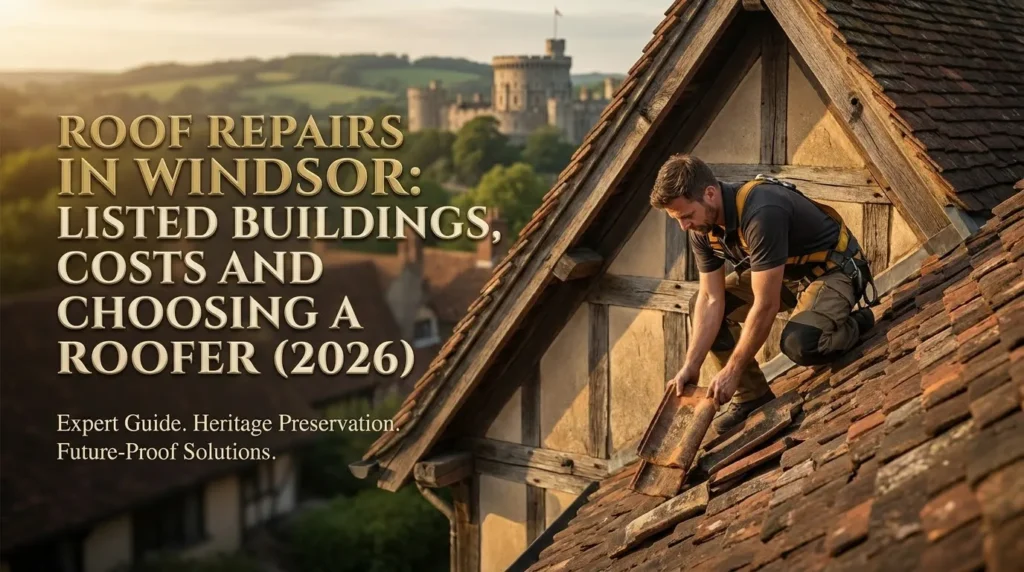
Few towns in Berkshire ask more of a roofer than Windsor. One street might hold a Georgian townhouse with Welsh slate and lead valleys, and a mile away sits a 1960s semi with a concrete-tile roof and flat-roofed garage. The right repair, the right materials and even the right paperwork differ completely. This guide explains what fails on each type, what repairs cost in 2026, when consent matters, and how to pick a contractor. A local team handling roof repairs windsor wide, from listed townhouses to Dedworth estates, is far likelier to know which approach your roof needs.
Windsor’s roofs by area and age
| Area and housing | Typical roof | Most common faults |
|---|---|---|
| Castle Quarter, Trinity, Park Street, Sheet Street (Georgian and early Victorian) | Welsh slate, handmade clay, lead valleys | Slipped slates from corroded fixings, fatigued lead, chimney flaunching and pointing |
| Clewer Village and Eton (period cottages and terraces) | Slate, plain clay tile | Frost-damaged tiles, worn lead around chimneys, failed lime mortar |
| Clewer, Dedworth (1950s–70s estates) | Concrete interlocking tile, 50–70 years old | Cracked tiles, crumbling mortar ridges, tired garage flat roofs, failed flashings |
| Old Windsor, Datchet, Oakley Green (larger and riverside homes) | Mixed: clay, slate, concrete | Moss and damp from tree cover, lead failures, wind exposure |
The pattern is simple: period roofs fail at the lead and fixings, while post-war estate roofs fail at the ridge and underlay.
Listed buildings and the Windsor conservation area
Windsor’s historic core includes many Grade II listed buildings and sits within the Windsor Town Centre Conservation Area. That changes what you can do, and what you should ask a roofer about.
- Listed buildings: like-for-like repairs that do not alter the building’s character often do not need consent, but changing materials, appearance or historic fabric usually requires listed building consent. Confirm with the Royal Borough of Windsor and Maidenhead’s conservation team before work starts.
- Conservation areas: routine repairs are generally treated as maintenance, but replacements should match the originals. Swapping slate for concrete tile on a visible slope is the classic mistake.
- Materials: historic roofs usually need natural slate or handmade clay, traditional lead dressed correctly, and lime mortar rather than cement. Cement is harder than old masonry and can cause damage.
Ask this first: “Have you repaired listed or conservation-area roofs before, and what will you use to match the existing materials?” A vague answer is a reason to keep looking.
What roof repairs cost in 2026
Published UK 2026 price guides broadly agree on these ranges. Windsor sits in the South East, so the upper half of each range is realistic, and heritage materials push costs higher.
| Repair | Typical UK cost (2026) | What pushes it up |
|---|---|---|
| Replace a few cracked or slipped tiles | £150–£500 | Clay or slate to match, discontinued profiles |
| Re-bed or re-point ridge tiles | £300–£900 per ridge line | Decorative clay ridges, ridge length |
| Dry ridge conversion | £900–£2,500 | Number of ridges and hips |
| Lead flashing or valley repair | £200–£600 | Chimney access, tile removal, correct lead code |
| Chimney repointing and flaunching | £500–£2,000 (with leadwork) | Height, lime mortar, multiple flues |
| Flat roof patch (felt, EPDM, GRP) | £200–£800 | Hidden deck damage |
| Scaffolding where required | +£500–£1,200 | Height, tall townhouses, tight streets |
Natural slate and leadwork cost more than concrete tile and felt, which is why a like-for-like repair on a Park Street townhouse will not price like a Dedworth semi.
Dedworth and Clewer: ridges, tiles and flat roofs
Most 1950s to 1970s housing here has concrete interlocking tiles bedded on mortar ridges. By 50 to 70 years old, three things usually give out: the ridge mortar, individual tiles weakened by frost, and the felt underlay beneath. Integral garages and rear extensions often have flat roofs that are well past their expected life.
For ridges, the choice is between re-bedding in mortar, which is cheaper upfront but will eventually crack again, and converting to a mechanically fixed dry ridge system, which removes the mortar problem and gives built-in ventilation. If you have already re-pointed once and it is failing again, price the conversion. On period properties the answer is different: decorative clay ridges are usually re-bedded carefully to keep the roof’s original appearance.
Warning signs worth acting on early
- Stains or damp patches on upper ceilings, which often appear weeks after the leak starts.
- Slate fragments, tiles or mortar crumbs in the garden or gutters.
- Chimney stacks with open joints, loose pots or cracked flaunching.
- Daylight through the loft roof when the light is off.
- Lead flashings that are cracked, lifting or pulling away from the brickwork.
- Water ponding on flat roofs for more than 48 hours after rain.
On older Windsor properties a small failure can travel. Water entering at a worn valley can soak timbers a long way from the visible stain, so inspect the loft as well as the ceiling.
Repair or replace?
Repair when faults are localised and the structure beneath is sound. Ask for a re-roof quote alongside the repair quote when faults keep appearing across different slopes, when photographs show perished underlay or soft battens, or when cumulative repair costs approach a third of replacement. On a listed building, even a re-roof must keep the original covering type, so involve the conservation team early.
How to choose a roofer in Windsor
Questions to ask
- Will the person who inspects the roof also carry out the work?
- Is the quote written and itemised, with scaffolding, materials and labour separated?
- Do they have experience with listed or conservation-area properties if yours is one?
- Is there a written guarantee, and can you verify reviews and membership such as Checkatrade or the Competent Roofer scheme (CORC)?
- Do they hold public liability insurance?
Red flags
- Unsolicited door-knockers claiming to have spotted damage.
- Pressure to decide the same day, or big cash deposits.
- A lump-sum price with no breakdown.
- Proposing cement mortar or modern substitutes on a historic roof.
Storm damage and insurance
High winds lift ridges, dislodge tiles and loosen flashings across the borough. Most buildings insurance covers sudden storm damage but not wear and tear. Photograph the damage from the ground, keep receipts for any emergency make-safe work, and tell your insurer before permanent repairs begin. A written roofer’s report supports a claim, and it helps to say clearly if the building is listed, since reinstatement must use matching materials.
FAQs
How much do roof repairs cost in Windsor?
Most UK roof repairs fall between £150 and £2,500 in 2026. A few tiles are typically £150–£500, ridge re-bedding £300–£900, flashing £200–£600 and a flat roof patch £200–£800. Natural slate adds roughly 50–80% over concrete tile, and scaffolding can add £500–£1,200.
Do I need permission to repair a listed building’s roof?
Like-for-like repairs often do not, but anything that alters materials, appearance or historic fabric usually needs listed building consent. Check with the Royal Borough of Windsor and Maidenhead’s conservation team before work starts.
Does a conservation area affect roof repairs?
Routine repairs are normally maintenance, but replacement materials should match the originals. Changing the visible appearance of the roof may need consent.
Should I convert crumbling mortar ridges to dry ridge?
On post-war estates in Dedworth and Clewer, usually yes, at around £900–£2,500, because it removes a recurring failure. On period roofs with decorative clay ridges, careful re-bedding is normally preferred.
Does home insurance cover storm damage to a roof?
Typically for sudden storm damage but not wear and tear. Document the damage, keep receipts and contact your insurer before permanent work.
Bottom line
Windsor’s roofs fall into two camps that need different thinking. Period roofs call for matching materials, correct lead work and an eye on listing or conservation rules. Post-war estate roofs call for sensible ridge, tile and flat-roof repairs before water gets past a perished underlay. Whichever you own, insist on a written, itemised quote, ask for photographic evidence, and fix small faults before the next wet winter finds them.
Describe the problem and get a no-obligation estimate for your Windsor roof repair. Get Free Online Estimate